New England Puritan Women’s Death Writings
“What have you been reading lately?” a friend asked.
“Well, I’m reading Agnes Grey for a book club, and Why Literature Still Matters and Mind to Mind for my Charlotte Mason group, oh and death writings of puritan women and their eulogies.” I know. This may seem weird, but hear me out.
I began this rabbit trail of reading eulogies by reading the writings of the puritans.
As you probably know, published female writers during the 1600-1700’s were few and far between. Women mostly wrote letters, personal narratives, theological thougths, and death instructions and thankfully some of their writings have survived. Some of the more familiar puritan women writers were Anne Bradstreet, the first writer in the New England colonies to be published, Lucy Hutchinson, a true intellectual who wrote a theological piece called On the Principles of the Christian Religion, and Mary Rowlandson’s work The Sovereignty and Goodness of God, one of the bestselling books by a woman about God’s goodness. We also have the letters of Brilliana Harley, around 400 of them, written to her son.
I’ve always been interested in the lives of women from other time periods, especially those from the New England area and particularly those who were Christian women. I marvel at how much they accomplished with so few resources. I admire their seriousness and singleness of mind. I respect their deep trust in God even though they all knew heartache and death and loss in abundance. But mostly I admire their committment to virtuous living especially since we swim in a culture where morality is, shall we say, elastic.
I think reading the old “archaic” work changes us and calls us out of our own self-congratulating assessment of our christian performance. It shows us where we are dedicated to comfort, blind to our own wickedness, worldly, distracted, soft, compromising. It gives us context and a bit of a reality slap. It transports us to another moment in time to experience its values and norms, and forces us to stare real grit and perseverance in the face. Reading of old virtuous women helps us consider ourselves and maybe see areas where we could strive to change.
So today, I want to share a few excerpts with you.
Cotton Mather, prominent puritan Boston pastor and prolific writer, published some of the these death writings and used them in his eulogies.
Mather praised the godly writings of Katherine Willard in her eulogy and commended them to us. He praises her for not only being an excellent home manager but also so industrious that “she was hindred not from the use of her pen, as well as of her needle.”
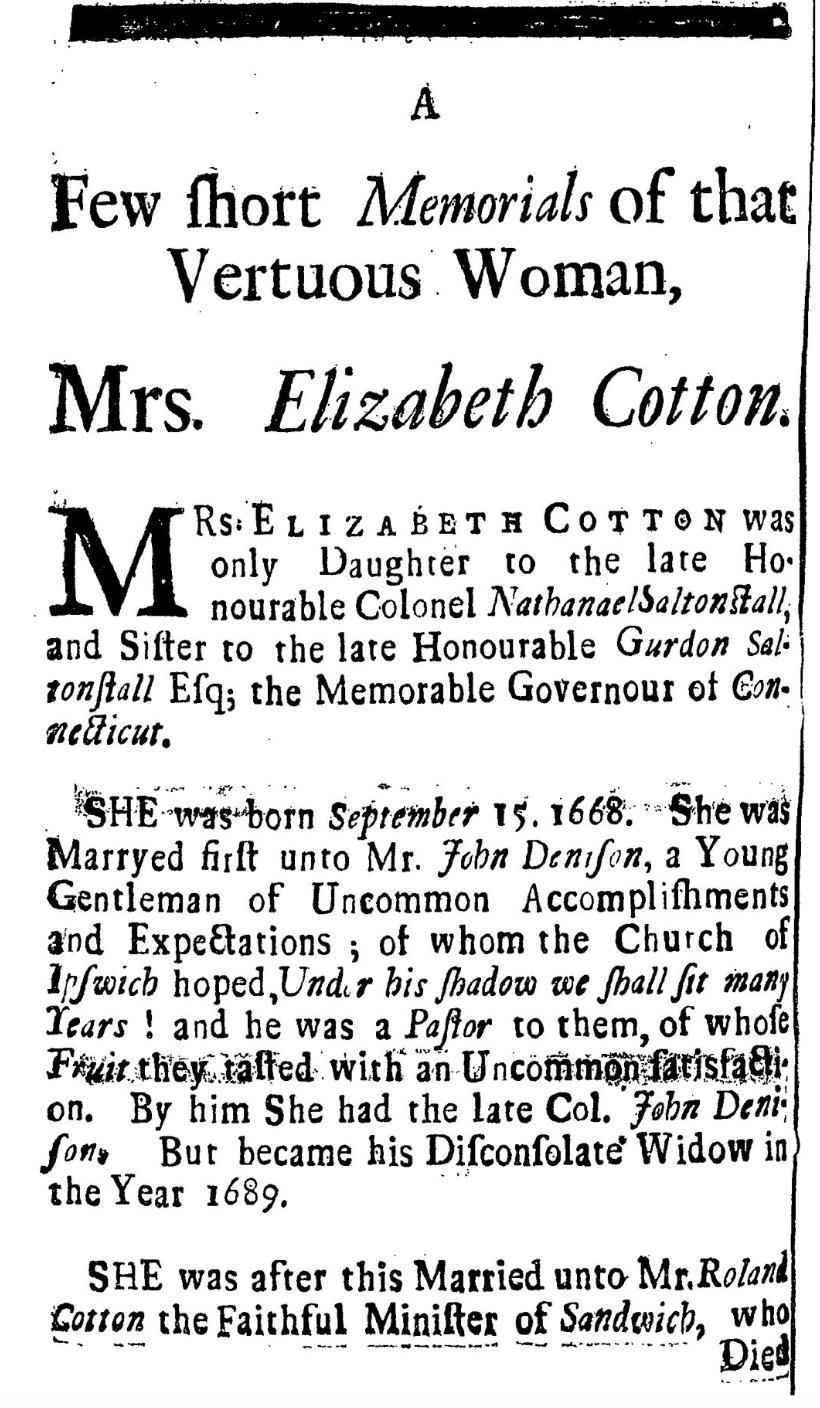
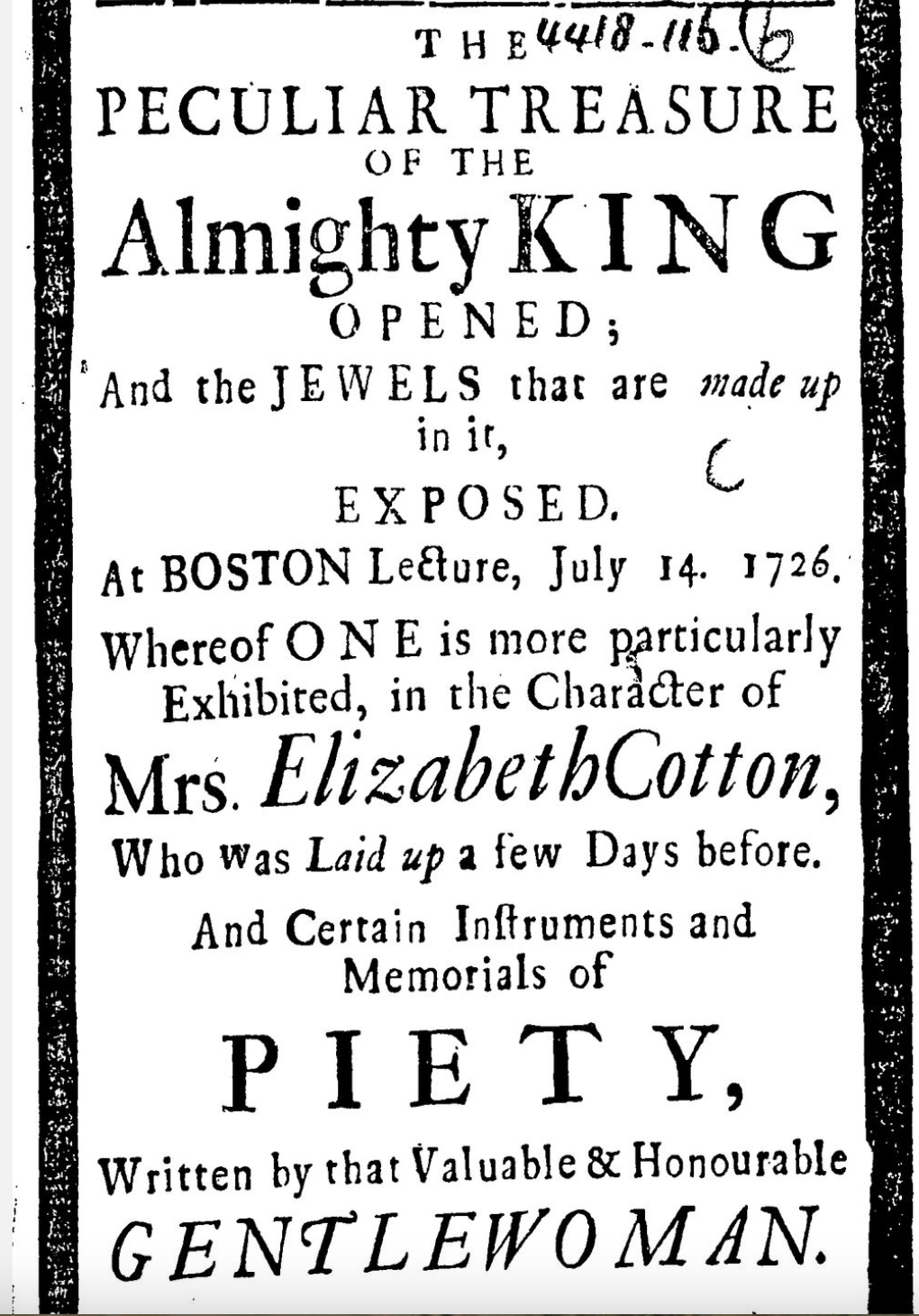
During the eulogy for Elizabeth Cotton, he speaks of the “monuments of her pen” and shares several excerpts in his sermon calling them “highly serviceable to the cause of piety. There is one of them so expressive and so instructive, that it may well pass for the best part of my sermon, if I now give to you all, and particularly the Daughters of our Zion, the benfit of hearing it read unto you.”
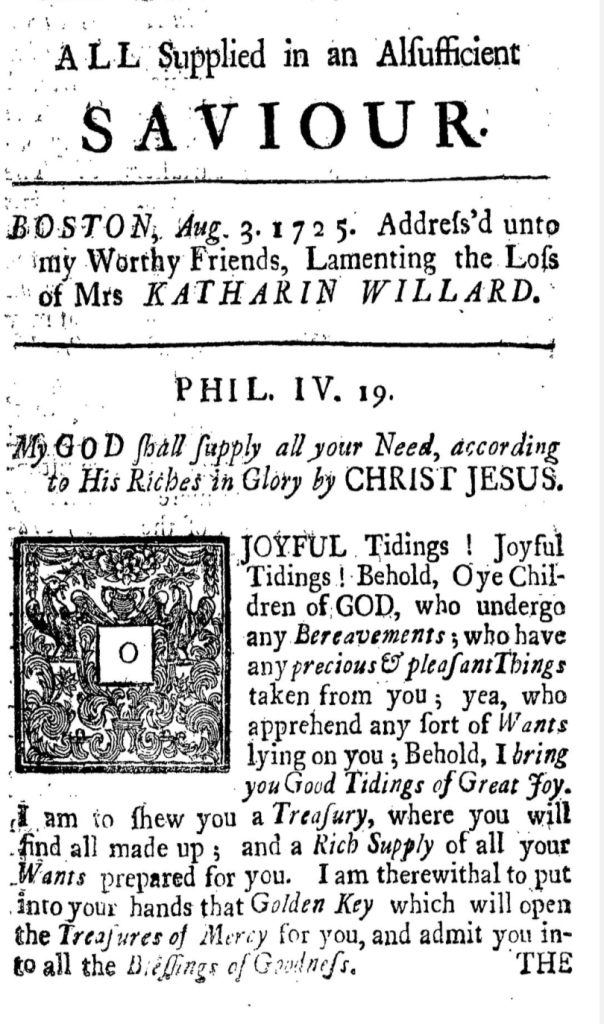
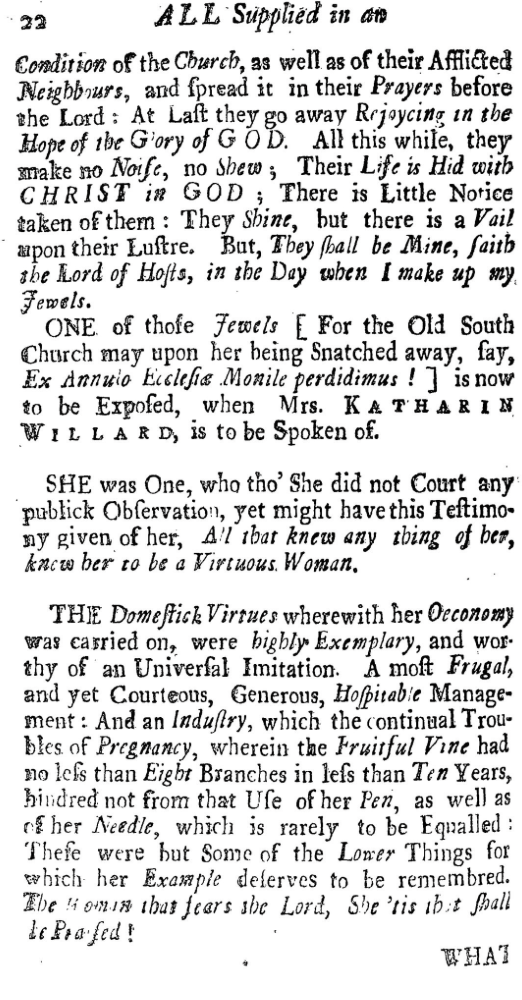
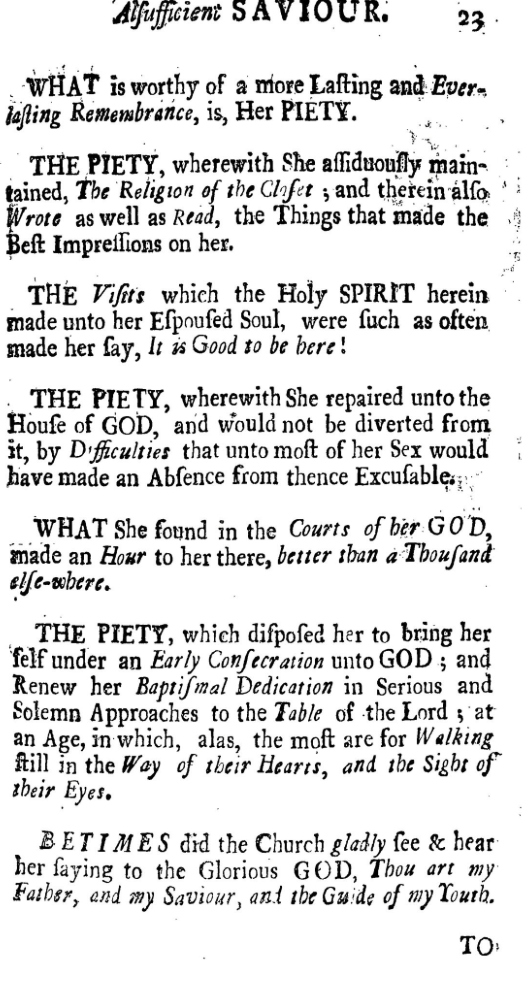
Of Katherine Willard, Cotton Mather wrote, “Though she did not court any public observation, yest might this testimony be given of her, All that knew any thing of her knew her to be a virtuous women” and worthy of “universal imitation.” She was ” most frugal, and yet courteous, generous, hospitable management.” She maintained “the religion of the closet” (prayer) and wrote as well as read the things that made the best impressions on her. ” He described her Christian manner as worthy in “an age in which, alas, most are for walking still in the ways of their hearts and in the sight of their eyes.”
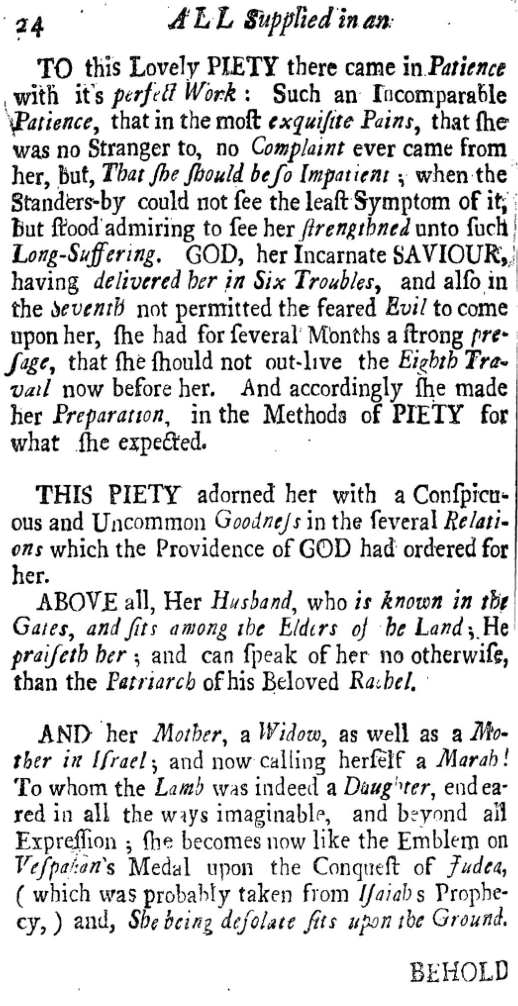
“To this Piety came in Patience with its perfect work. Such an incomparable patience, that in the most exquisite pains, that she was no stranger to, no complaint ever came from her, that she should be so impatient; when the standers-by could not see the least symptom of it, but stood admiring to see her strengthened into such long-suffering.”
Sarah Goodhue, a woman from Ipswich, MA wrote a letter to her husband and children days before she was to deliver twin babies. She must have known that the reality of the time was that she may die in child birth. She did die three days later, leaving ten children in total. She gives her wishes for the dividing of her children among her relatives, encourages her husband to trust in the Lord.
“Dear and loving Husband,
if it should please the Lord to make a sudden change in thy family, the which I know not how soon it may be, and I am fearful of it: Therefore in a few words I would declare something of my mind, lest I should afterwards have no opportunity: I cannot but sympathize and pity thy condition, seeing that thou hast a great family of children, and some of them small, and if it should please the Lord to add to thy number one more or two, be not discouraged, although it should please the Lord to deprive thee of thy weak help which is so near and dear unto thee. Trust in the living God, who will be an help to the helpless, and a father to the motherless;…”
O my children be sure to set the fear of God before your eyes ; consider what you are by nature, miserable sinners, utterly lost and undone; and that there is no way and means whereby you can come out of this miserable estate; but by the Mediation of the Lord Jesus Christ: He died a reproachful death, that every poor humble and true repenting sinner by faith on God through him, might have everlasting life:
O my Children, the best counsel that a poor dying Mother can give you is, to get a part and portion in the Lord Jesus Christ, that will hold, when all these things will fail; O let the Lord Jesus Christ be precious in your sight…
Brothers and Sisters all, hearken and hear the voice of the Lord, that by his sudden providence doth call aloud on you, to prepare yourselves for that swift and sudden messenger of death: that no one of you may be found without a wedding garment; a part and portion in Jesus Christ: the assurance of the love of God, which will enable you to leave this world, and all your relations, though never so near and dear, for the everlasting enjoyment of the great and glorious God, if you do fear him in truth.”
THE COPY OF A VALEDICTORY AND MONITORY
WRITING
Her letter to her family in its totality is here.
These letters have been such an encouragement to me and I hope to share a few more in the future.
Do you write for your children and grandchildren? If so, let me know in the comments how you go about this. Is it in a journal somewhere? Are they letters to your children?
I’m always thankful for those who have gone before us who had the forethought and discipline to write for future generations!
This post contains Amazon affiliate links.